
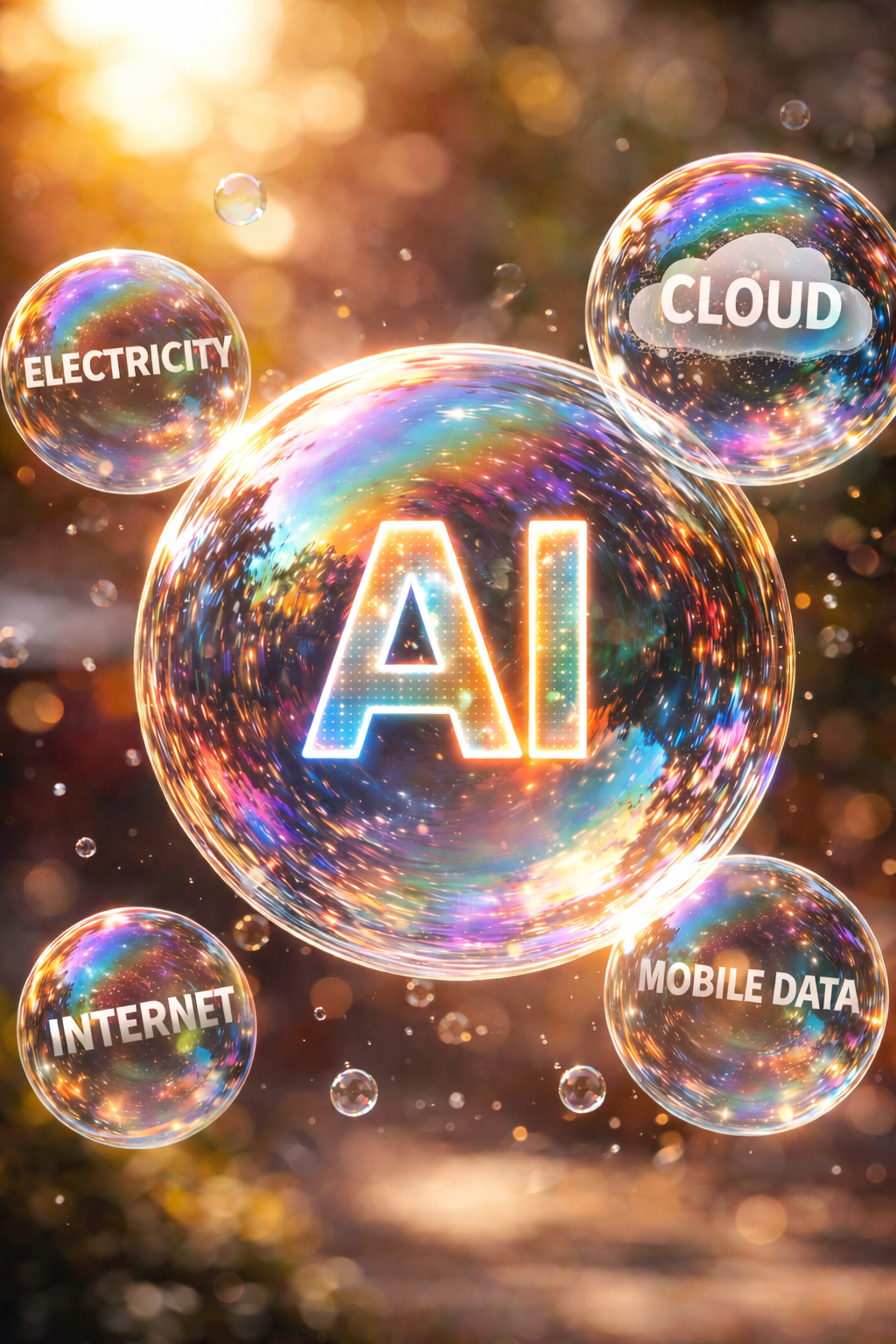
Image Courtesy:ChatGPT
Will the AI bubble burst? History says no. Every major technology, from electricity to cloud computing, was declared a doomed bubble before it became essential infrastructure. AI is following the same pattern.
Exploring the Question: Will the AI Bubble Burst
Lately, conversations about AI have begun to change tone. Will this AI bubble burst or will it sustAIn? Will the AI bubble burst is a question many are pondering. Many experts are asking, ‘Will the AI bubble burst?’ as they analyze the current landscape.
After the initial euphoria, awe, amazement, and fear of missing out, reality is starting to set in. Enterprises are realizing that while large language models are powerful, they are also expensive. Training costs are high, but inference costs are often the real surprise. Every prompt, every response, and every token carries a compute cost. GPU time, energy consumption, latency, and cloud bills scale linearly with usage. These costs accumulate quietly in the background.
As we consider the future, one cannot help but wonder: will the AI bubble burst in the next few years, or will we continue to see growth? Many are optimistic that the potential of AI will keep the bubble from bursting.
As a result, a growing chorus of experts is predicting that the AI bubble is about to burst.
The volume of articles and analyst reports warning of an imminent collapse continues to rise. Many analysts appear to be betting on AI’s failure. This may sound dramatic, but it also sounds familiar.
We have seen this pattern before, not once or twice, but countless times.
For thousands of years, humanity has greeted every meaningful technological shift with the same mix of fascination, anxiety, and firm conviction that this time, the bubble will burst. Yet that conclusion feels premature.
The question, ‘will the AI bubble burst?’ is not just rhetorical; it drives discussions across industries as we evaluate technology’s trajectory.
Expensive today does not mean economically unviable tomorrow. History does not support the idea that cost shock reliably signals a bubble burst. Technology bubbles tend to collapse when there is no real demand or when the value created is illusory. AI satisfies neither condition.
Demand for AI is not speculative. It is tangible and already embedded in analytics, productivity, compliance, software development, and more. The value may be uneven and occasionally overstated, but it is undeniably real.
What we are witnessing is not a collapse in demand or value. It is reality catching up with expectations. Every major technology goes through a phase where excitement outpaces engineering. AI is firmly in that phase today.
Those who remember the early days of cloud computing will recognize this pattern. Cloud was initially marketed as cheaper than on-premises infrastructure. Security and reliability concerns followed. Then enterprises realized their cloud bills were higher than expected. Soon after, commentators declared that cloud economics were fundamentally broken.
“Cloud computing is a trap.” – Richard Stallman
What followed was not abandonment, but refinement.
Hybrid architectures emerged. Edge computing addressed latency and cost. FinOps introduced discipline and governance. Cloud did not burst. It settled into its role as core infrastructure.
We have seen this cycle many times. In every successful case, the technology did not disappear. It matured.
Electricity shocked society before it rewired the world.
“The use of alternating current is a foolish fad.” – Thomas Edison
The internet did not collapse as predicted. It quietly permeated everything.
“The internet will catastrophically collapse in 1996.” – Robert Metcalfe, 1995
Mobile data did not overwhelm networks. It made work portable.
In discussions about market trends, the phrase ‘will the AI bubble burst’ often comes up, highlighting the uncertainty that surrounds emerging technologies.
“There is no reason anyone would want a computer in their home.” – Ken Olsen, 1997
Each of these technologies faced similar anxieties around cost, security, and unintended consequences. AI is following the same trajectory.
Yes, large language models are expensive today. But cost shock is not a bubble-burst signal. It is an early-adoption signal.
For many, the question ‘will the AI bubble burst?’ serves as a reminder to stay cautious and aware as we proceed with AI innovations.
The industry has already begun making corrections. Smaller language models are emerging as cost-effective solutions for focused use cases. They are efficient and capable, but they are not replacements for large models. They are complements. Engineering will catch up with excitement, and as history suggests, it will eventually surpass it.
Legal challenges around training data will also find resolution. Data will be licensed, regulated, and governed more carefully. AI will become more structured and responsible, not extinct.
We no longer need to be Isaac Newton, Albert Einstein, or Aryabhata to access centuries of accumulated knowledge. A few well-crafted prompts can surface insights built on thousands of years of human thought. The playing field is being permanently leveled.
For a species that has long romanticized effort, struggle, and persistence as prerequisites for insight, this shift will be deeply disruptive. As much as we like to think we love disruption, humans crave the boring. Predictability comforts us. AI is still in its infancy, so feeling anxious about it is only human.
I remain optimistic about AI’s future and its impact on humanity. We are experts at using the difficulties to thrive. We have done this since the Pleistocene Glaciation or the end of the last ice age.
But one practical concern persists. If AI multiplies productivity, and it will, what happens to jobs? More importantly, if large segments of society become unemployed or underemployed, who will purchase the efficiently mass-produced goods AI helps create?
As we ponder these concerns, the question remains, ‘will the AI bubble burst?’ and how will society adapt to the changes brought by AI?
Who knows.
Perhaps AI itself will help answer that question.
“We tend to overestimate the effect of a technology in the short run and underestimate the effect in the long run.” – Roy Amara
As we navigate these discussions, the phrase ‘will the AI bubble burst’ echoes in the minds of many, emphasizing the critical need for thoughtful responses to technology’s impact.

A good read. I completely agree that the success lies in the way we are going leverage AI (usecase). Those who will build use cases that solve real problems will sustAIn (loved this).
Hi Bhaskar,
A well-timed and thoughtful article. While the discussion around an “AI bubble” is valid, I strongly believe the real value of AI lies in practical, responsible usage. In my workplace, AI has already proven to be a powerful enabler, improving productivity, decision-making, and learning, without replacing human judgment. When used with clarity and intent, AI is less about hype and more about amplifying human capability.
AI adoption and proliferation are defined by leadership intent and the thoughtfulness behind its application, not by hype alone.
Thank you for sharing a good thought for the day
An excellent blog, Bhaskar. For me as Sequretek, an AI powered Cybersecurity platforms , products and services company, I see many use cases and AI models that we use helping customers reduce alert fatigue, speed of threat detection and response as well as predictability of AI based cyberattacks. AI combined with automation reduces the number of people needed in the Security Operation Centres that otherwise would have to increase in linear proportion compared to legacy environments, while making it more agile. It also solves the talent pool problem in cybersecurity. Having said that the real challenges of test data, data poisoning and compute power are on the rise. We balance human intelligence along with AI to offer holistic solution. I see human in the loop using Gen AI / Agentic AI for now to help in generating optimum benefits of the technology. The landscape will change in another 5 years when AGI becomes the new norm. Like internet, the benefits of AI will take time and will not meet expectations in the short run. The greed of the share markets will not be satiated in 2026 and may cause a financial upheaval and other crisis akin to the past. But the technology will endure and provide long term benefits to the sustained efforts of the industry. Skill augmentation and curriculum will change from answers to prompt engineering. The world as we know now will transform. People will lose jobs and new jobs will be created. Change as they is constant. We have to adapt, adopt and be adept.
Every invention / scientific advancement is akin to a journey, a starting point, a destination and a route. Strategizing, which adopts this template (and particularly in business) adds another aspect – “how do we know when we get there” – in terms of key indicators.
Every technological advancement had a defined objective, or, was meant to solve a specific problem – whether networking across geographies cheaper and faster, or communicate without wired infrastructure, or squeeze more efficiencies from under- utilised compute resources. The destination was clear and we had a way of knowing when we got there.
Now, what’s such a destination for AI ? Intelligence is a continuum – what is the point that we’re aiming for, as in, those pouring billions into this quest ? And what do we want to get out of it – write text or draw pictures or automate a process, and if so, which process or what kind of text or picture ? How much more money can be thrown at a pursuit, the objective of which is yet unclear and the outcomes reflect the story of four blind men and an elephant ?
Surely good things will come out of all this research – energy efficient data centres, better processors and so forth. But those weren’t the destinations, as Columbus would probably reflect !!
Valid points Sunil. AI, like electricity or internet is more like a platform than a product.This versatility helps with the flexibility. Cloud, for instance, started as a replacement for on-prem infra, quick deployment etc but today that is a small part of what it does. It is the base for SaaS and how softwares are developed and deployed. Like all these other technologies that started with certain objective have evolved to create deeper impact. AI will follow the same path. Yes, cost of building is high and this is not for the smaller shops that talks about AI. I could be wrong but history has seen such survival against odds and evolution of technologies. So why not give AI that benefit of doubt.
I would say sustAIn with “A Pause”. The investment currently going into is not even generating the 3% of revenue forget the profit but that also signals metaphor of solutions. As per the current usage especially in medical and manufacturing I am finding it very useful. Let’s wait and watch
It’s early days to judge and write off AI. The technology would adapt and evolve, as have all the previously written off but game changing techs of today.
That’s a wonderful perspective and it’s true as well. The reality of adopting AI is kicking in now
Very insightful read Bhaskar. I really think that we will move to an era of Pre-AI and Post-AI, as this shift (to your point) is profound and builds on top of prior technology breakthroughs. Today the cost of people > cost of compute within an enterprise, tomorrow the cost of compute > cost of people, that’s the tipping point from a societal standpoint.
I would really love for your to don your perceptive 2030 visionary glasses and make predictions on the society of the future.
Well done!!!
Well written, Bhaskar. From what we’re seeing, AI costs are rising, expectations are stretched, and the infrastructure is still immature, which is exactly what early product–market fit looks like. I don’t think it bursts from here; it becomes boring, essential, and steadily more optimized.
Well written. AI was marketed as the magic solution that did everything rather than a tool that helped. And as all tools, we will only use it to complicate our lives more than simplify it. So yeah, AI will remain and slowly become the new normal.
Really insightful article Bhaskar. I liked how you covered the topic in depth, touching every important aspect without making it overwhelming. The perspective feels very practical, balanced with an optimistic outlook. Each point was relatable and well connected to historical experiences, which makes the arguments even more credible. Overall, a well researched and engaging read Bhaskar.
Thanks Bhaskar, for looking AI from evolving lens , value preposition it is bringing along with amplified productivity. Yes with amplified pace producer – consumer equation is in stressed state as our consumers are neither equipped nor ready for consuming the level of produce.
On other hand this amplification also create new avenues as AI infancy matures, which I am sure tapped by these consumers, along with generation of new parallel streams .
Bhaskar, I really liked your references to past disruptors and how innovations that once seemed chaotic or threatening eventually became accepted as the norm. Every disruption initially creates an impression of disorder, but when guided with the right guardrails and purpose, it ultimately brings meaningful benefits to our lives AND, AI will be no different.
We’ve seen this cycle even when computers were first introduced — remember the backlash and fear of job losses when computers were first introduced? Looking back, those concerns almost feel humorous now, considering how many new opportunities and industries emerged because of that shift.
Your post is a timely reminder that while change may feel uncomfortable at first, history shows that thoughtful adoption consistently leads to progress.
Like a river, it bends around barriers, adapts to the terrain, and reshapes the landscape as it flows onward.